This article may contain affiliate links. We may earn a commission at no additional cost to you.
Table of Contents
- Introduction
- System Design for Indoor Odor Control
- Throughput, Airflow, and Nutrient Conversion
- Fit, Compliance, and Space Optimization
- Castings, Soil Performance, and Consumer Outcomes
- Conclusion
Introduction
Indoor vermicomposting allows household food leftovers to be converted into soil-building castings without outdoor space, odors, pests, or seasonal interruptions. Modern bins use controlled airflow, sealed lids, and moisture regulation to support aerobic decomposition in small kitchens, condominiums, dorms, and apartments. These compact systems serve as efficient consumer tools for waste diversion, soil improvement, and reduced dependence on synthetic fertilizer inputs. The systems run quietly, operate year-round, and require minimal handling while promoting continuous sustainability outcomes at the household level.
System Design for Indoor Odor Control
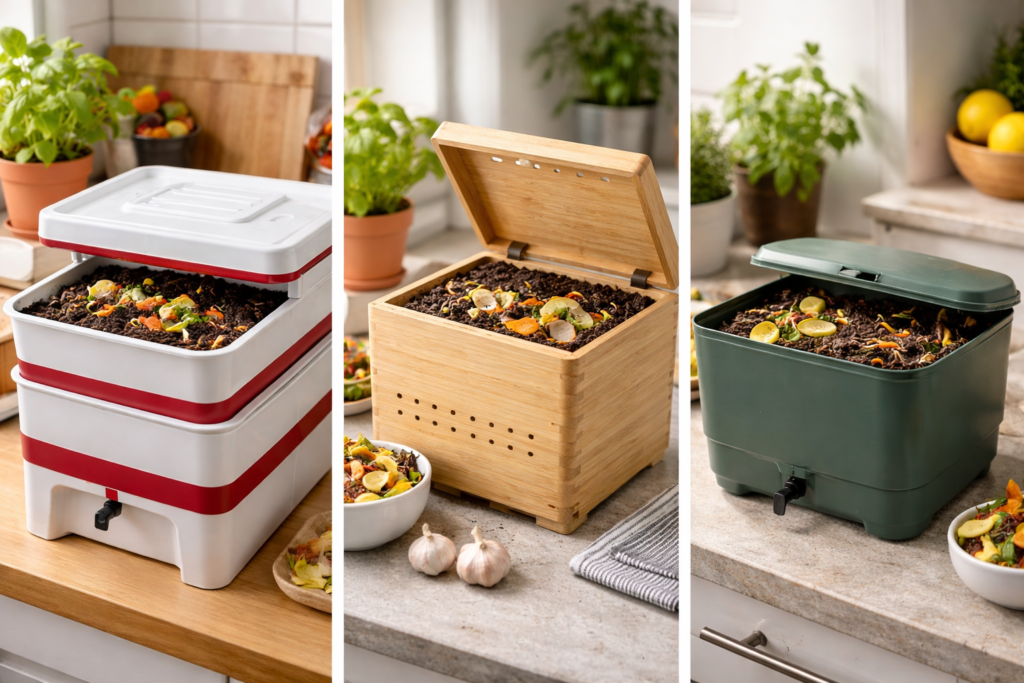
Indoor vermicomposting bins depend on engineered geometry, moisture management, and vented airflow to prevent anaerobic odor formation. Stackable trays permit vertical oxygen diffusion, while perforated floors maintain porosity and reduce bedding compaction. Bedding made from shredded paper, coir, or wood fiber maintains structural voids that minimize fermentative pockets and suppress odor compounds. Base drains prevent leachate accumulation and reduce volatilization of ammonia and organic acids. Lid seals limit fruit flies and fungus gnats, while vent patterns allow steady gas exchange without drafts. These features enable indoor operation next to food preparation areas without degrading indoor air quality or violating shared household expectations regarding cleanliness and odor control.
citation
citation
Throughput, Airflow, and Nutrient Conversion
Throughput is determined by feed surface area, worm density, bedding composition, and thermal range. Tray systems increase interface between feedstock and Eisenia fetida worm populations, accelerating breakdown of cellulose, carbohydrates, and proteins into castings enriched with humic fractions and plant-available micronutrients. Airflow reduces anaerobic fermentation and suppresses volatile sulfur and ammonia species. Optimal temperature ranges between 65–80°F promote worm reproduction and microbial metabolism, enabling predictable weekly or biweekly feeding intervals. Castings migrate downward while worms climb upward toward fresher feed trays, simplifying harvest and reducing handling time. This cycle lets consumers achieve stable soil amendment production using leftovers that would otherwise be discarded into trash streams or municipal organic carts.
citation
citation
Fit, Compliance, and Space Optimization
Indoor bins align with municipal waste diversion strategies aimed at reducing organics in landfill streams. The systems occupy minimal volume and fit into counter corners, pantry floors, or under-island recesses, avoiding conflicts with shared housing rules or HOA exterior restrictions. Ergonomic lids, drip taps, and removable trays reduce mess and improve user compliance. Households with limited outdoor access gain year-round composting capacity and maintain organics diversion even during winter conditions. Some jurisdictions incentivize organics diversion through reduced waste cart volumes or sustainability credits, and indoor vermicomposting provides an accessible pathway for apartments and condominiums to participate in such frameworks. Reduced odor and pest risk improve social acceptance among roommates and shared kitchens, expanding applicability beyond detached single-family residences.
citation
citation
Castings, Soil Performance, and Consumer Outcomes
Finished castings possess granular texture and strong aggregation properties that enhance root penetration, moisture retention, and cation exchange capacity in container media. Indoor gardeners and culinary growers observe improvements in herb vigor, leaf density, flowering performance, and flavor profiles attributed to bioavailable nutrients and microbial interactions at the rhizosphere. Castings blend easily with potting soil, peat alternatives, or coconut coir without requiring high application rates. For consumers, these advantages establish a closed-loop routine that converts household leftovers into horticultural value while reducing reliance on commercial fertilizers and eliminating plastic packaging waste. Year-round production supports propagation, transplanting, and top-dressing cycles with consistent biologically active material, making the system useful for novice and experienced growers in constrained living environments.
citation
citation
Conclusion
Indoor vermicomposting systems provide households without yards a practical method to convert leftovers into castings while maintaining odor control, pest exclusion, and compliance with shared living constraints. Through engineered airflow, moisture management, and modular tray design, these systems achieve predictable throughput and generate soil amendments with measurable horticultural benefits. Their compact footprint, ergonomic interfaces, and sustainability outcomes give consumers a quiet, durable, and year-round pathway to reduce waste, improve soil performance, and engage directly in closed-loop nutrient cycling within kitchens and apartments.
Citations
(1) Edwards, C.A., 2011, Vermiculture Technology, CRC Press.
(2) Dominguez, J., 2018, Biology of Eisenia spp., Applied Soil Ecology, Elsevier.
(3) Arancon, N.Q., 2010, Vermicompost in Horticulture, Compost Science & Utilization.
(4) Atiyeh, R.M., 2002, Humic Fractions in Vermicompost, Bioresource Technology.
(5) Eastman, B., 2020, Indoor Organics Diversion, Municipal Sustainability Review.
(6) Gajalakshmi, S., 2015, Vermicast Effects on Crops, Waste Management Journal.
(7) Hickman, J., 2021, Aerobic Composting in Confined Spaces, Urban Ecology Bulletin.
(8) Brown, K.H., 2019, Root–Microbe Interactions in Potting Media, Horticulture Science.
