This article may contain affiliate links. We may earn a commission at no additional cost to you.
Seeing flies or maggots in compost shocks beginners, but it does not mean the pile is ruined or dirty. Insects appear when food is exposed and unbalanced, not because compost is bad. Fix the coverage and structure and they disappear naturally. You can check the correct cover balance quickly using the helpers at CompostingSupplies.com
What You Are Seeing — The Crawling Surprise
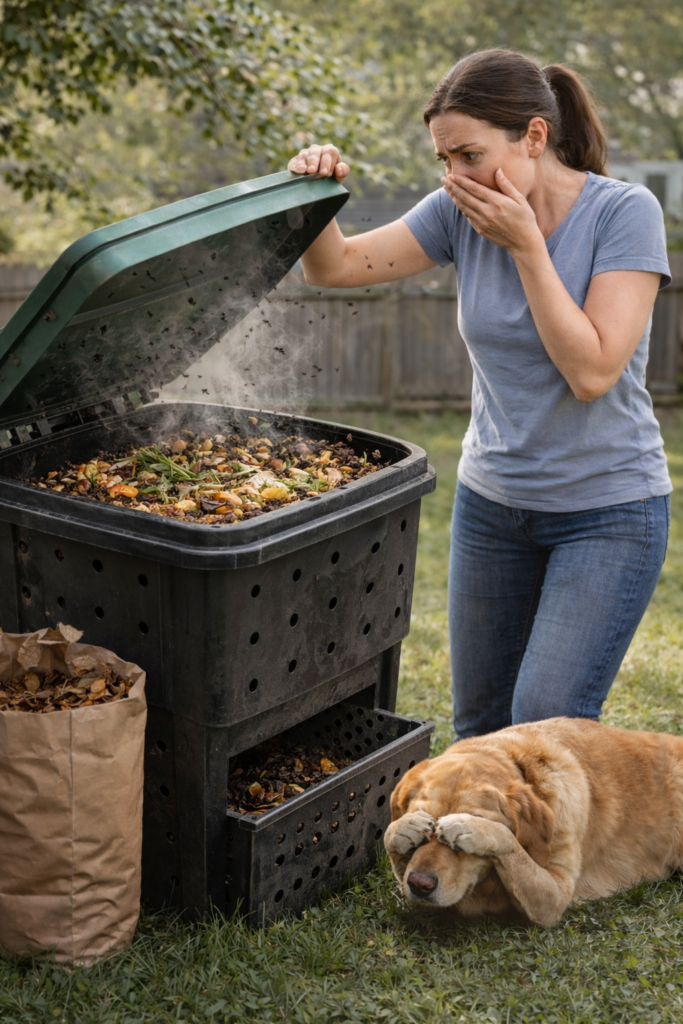
You lift the lid and small flies scatter. Under the surface you may see pale larvae moving in clusters. The pile may also smell stronger than usual.
This happens when fresh food scraps sit uncovered or too wet near the surface. Insects detect exposed nitrogen materials quickly. They are not attracted to finished compost — only fresh food.
The bin is not infested.
It is simply advertising dinner.
Cover depth controls insects more than temperature or bin type.
What It Means — The Short Science
Flies search for protein and moisture. They lay eggs where microbes have not yet taken over.
If oxygen and carbon cover the scraps, bacteria colonize first.
If scraps stay exposed, insects colonize first.
So insects are early recyclers replacing microbes temporarily. Once buried and balanced, microbes dominate again and insects leave.
They are a timing signal, not a sanitation problem.
Check cover balance: CompostingSupplies.com
What To Do Right Now — 3 Minute Fix
Do this immediately:
Push exposed food into the center
Add a thick layer of dry browns
Close lid and leave for one day
Use leaves, shredded cardboard, or paper. You need an odor barrier and air structure at the same time.
Within 24 hours activity drops dramatically.
Within 48 hours insects are mostly gone.
Do not spray anything.
Chemicals slow the good microbes.
How To Prevent — The Bury Rule
Every food addition must disappear the moment it enters the bin.
Follow this habit:
Add scraps → cover completely → no color visible
Keep a dry material container beside the bin so covering takes seconds. When food cannot be seen, insects cannot detect it.
Compost succeeds by hiding nitrogen inside carbon.
Use the ratio helper: CompostingSupplies.com
Why Fruit Scraps Trigger Swarms
Fruit releases sugars and moisture rapidly. That scent travels farther than vegetable scraps. If left uncovered even briefly, insects arrive quickly.
Bury fruit deeper than other materials and always follow with a thicker brown layer. Moisture plus sugar equals attraction.
Moisture control reduces insects more than temperature does.
When Maggots Are Actually Helpful
Larvae break soft material rapidly and generate heat. Many functioning compost systems include them temporarily. They become a problem only when populations stay high because food remains exposed.
Balanced piles shift back to bacteria dominance automatically. When structure improves, larvae leave without intervention.
You are correcting conditions, not removing creatures.
Fast Reference Chart
Symptom — Cause — Fix
Small flies — Exposed scraps — Cover with browns
Maggot clusters — Wet nitrogen — Add dry material
Strong odor — Anaerobic pocket — Mix and cover
Flies returning daily — Surface feeding — Bury deeper
Only fruit areas active — Sugar exposure — Thicker cover
Insects vanish after turning — Oxygen restored — Maintain structure
Quick Action Checklist
Bury all food immediately
Add two handfuls dry cover per addition
Keep browns beside the bin
Avoid leaving lid open
Mix weekly to reset structure
Flies and maggots mean the pile is decomposing, just with the wrong first responders. Once scraps are buried and balanced, microbes take over and insects leave naturally. Composting works best when food disappears under carbon quickly and consistently.
