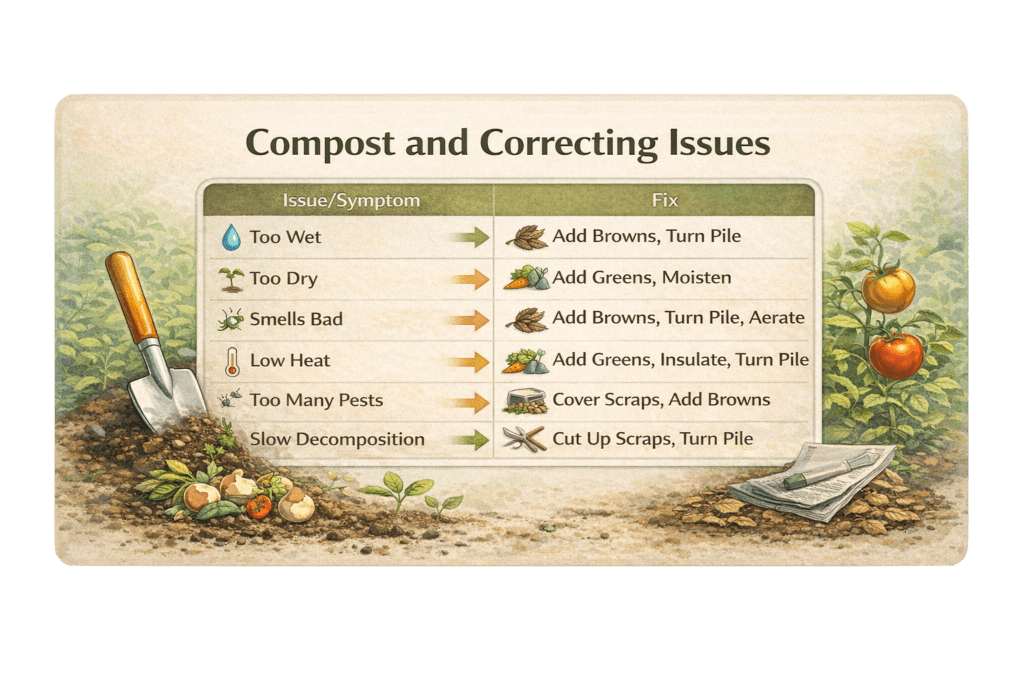
Compost Troubleshooting and Corrections
This reference helps composters solve problems fast by matching visible symptoms to likely causes. Slimy piles, ammonia odors, cold piles, pests, and mats all have predictable fixes once you understand carbon, nitrogen, moisture, and airflow. Each symptom links to a mistake, a reason, a correction, and a recommended material or tool so beginners and advanced composters can troubleshoot without guessing. It works for tumblers, bins, Bokashi systems, and soil trenching, and helps improve speed, reduce odor, and keep piles balanced through the season.
| Symptoms | Possible Mistake | Why It Happens | Fix | Recommended |
|---|---|---|---|---|
| Wet, slimy, ammonia odor, flies | Too Much Green Material | Nitrogen overload + low aeration | Add browns, increase airflow, rotate/mix | Shredded cardboard, dry leaves, sawdust |
| Dry pile, zero heat, static breakdown | Too Much Brown Material | Carbon overload stalls microbial activity | Add greens + light misting to sponge level | Grass clippings, kitchen scraps, manure teas |
| Puddles, sour smell, anaerobic zones | Pile Too Wet | Drainage failure + excess greens | Add absorbent browns + open airflow | Sawdust, shredded paper, pine flakes |
| Slow decomposition, fungal crusting, no heat | Pile Too Dry | Microbes halt without moisture | Mist pile until sponge-like | Hose sprayer, compost moisture meter |
| Recognizable chunks months later | Particle Size Too Large | Low surface area slows microbial access | Chop, shred, blend or re-feed | Garden shears, food chopper, blender |
| Rotten odor, compaction, layered mats | Low Aeration | Fats + grass + moisture drive anaerobic decay | Add bulky carbon + turn pile | Wood chips, leaf litter, turning fork |
| Maggots, pests, ammonia odors | Adding Meat/Dairy to Aerobic Pile | Proteins ferment poorly in open systems | Bokashi then bury or trench compost | Bokashi bucket, bran, curing bin |
| Worms avoid soil zone temporarily | Acid Shock (Bokashi Stage) | Low pH fermentation phase | Second-stage curing 2–4 weeks | Bokashi bran, soil-inoculated curing box |
| Cold pile, stalled fermentation | Overloading Volume | Microbial capacity exceeded | Feed smaller batches + rotate | Dual-chamber tumbler |
| Slow rot, fungal mats, pest attraction | Low Temperature | Below 100°F = weak thermophilic activity | Add greens + insulate + turn | Insulated tumbler, compost thermometer |
| Strong smell, slow breakdown, white molds | Too Much Citrus | Acidity + antimicrobial oils inhibit microbes | Mix evenly, dilute with browns | Dry leaves, shredded cardboard |
| Dense mats, hydrophobic crust | Too Many Coffee Grounds | Fine particle size restricts airflow | Mix into browns, avoid pure layers | Leaves, paper shreds, coco coir |
| Slimy green mats, flies | Grass Clippings Mats | High moisture + nitrogen + fine texture | Thin layers + mix + browns | Sawdust, dry leaves, wood chips |
| Dry pile, fails to heat | Over-Turning | Heat escapes before thermophilic stage | Turn less often + re-balance | Moisture meter, thermometer |
| Cold anaerobic layers | Under-Turning | Oxygen starvation + compaction | Turn weekly during peak activity | Turning fork, aeration tool |
| Pile stalls or overheats | Wrong Bin for Climate | Thermal mismatch to season | Insulate or ventilate appropriately | Insulated bin, slatted bin |
| Wet garbage texture | Not Enough Browns | Carbon/nitrogen imbalance | Add carbon + structure | Cardboard, newspaper, pellets |
| Cold fungal pile | Not Enough Greens | Low nitrogen slows bacteria growth | Add greens or manure | Fresh grass, manure, kitchen scraps |
| Odor + maggots + slime | High Fat Content | Fats and oils reduce oxygen diffusion | Bokashi first or trench bury | Bokashi bran, bucket |
| Worms climb walls, avoid bedding | Wrong pH for Worms | Acid fermentation or citrus overload | Buffer with calcium carbonate | Agricultural lime, oyster shell flour |
| Rodents, raccoons, scavengers | Vermin Access | Protein/odor signals attract pests | Enclose bin + bury post-Bokashi | Rodent-proof bin, trench method |
| Never heats, fungal-only breakdown | Pile Too Small | Thermal mass insufficient for bacteria | Increase volume to 3×3×3 | Bulk browns + greens |
| Plant burn or nitrogen loss | No Cure Phase | Unfinished compost applied early | Cure 2–4 weeks | Curing bin, soil tote |
| Slime on soil surface, fungus gnats | Applying Too Wet | Anaerobic residue persists | Air-dry compost before use | Screening tray, tarp |
| Rocks, plastics, sticks in final product | Skipping Screening | Mixed feedstock not sorted | Screen after curing | Compost screen, mesh sifter |