Composting Additives and Nutrients for Boosting the Breakdown Process
Composting Additives and Nutrients for Boosting the Breakdown Process
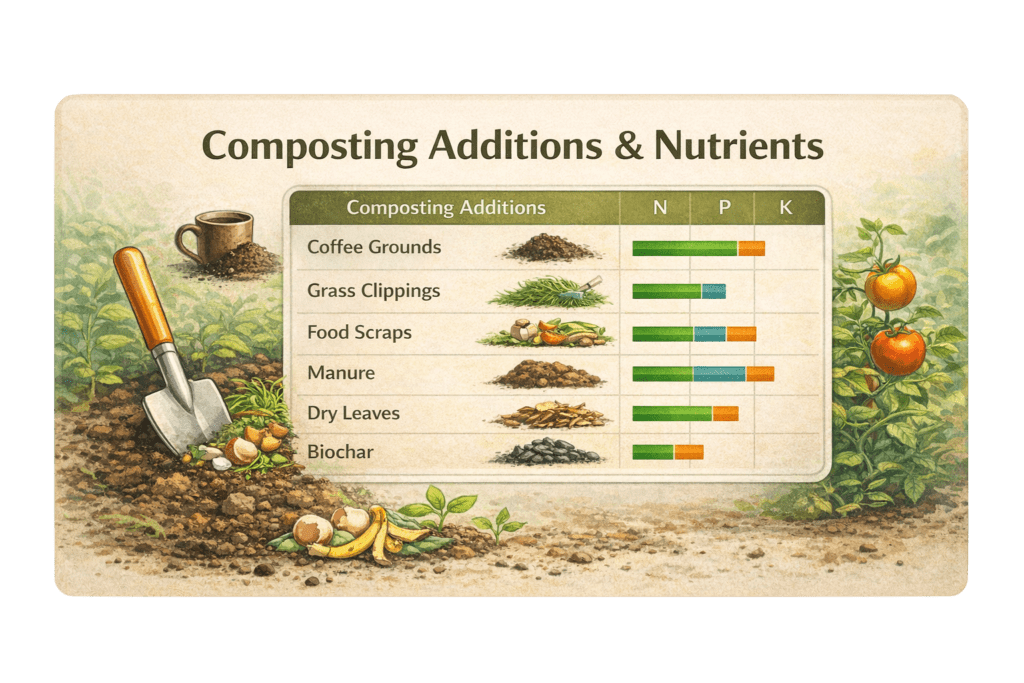
Additives and nutrient boosters can dramatically change how fast a compost pile heats, how well it breaks down, and how balanced the finished material becomes for soil use. Traditional hot composting and worm bins both respond differently to nitrogen sources, mineral amendments, microbial stimulants, and pH modifiers, which is why beginner systems often benefit from gentler materials while advanced systems can incorporate faster or more concentrated additives. The chart below compares the most common compost boosters used in backyard gardens, urban worm bins, and small homestead operations, showing compatibility, nutrient influence (NPK), dosing guidance, and cautions for those who are learning to fine-tune their compost for better results.
| Additive | Benefit / Use Case | Compost | Worm Bin | NPK (Relative) | Application Rate | Skill Level | Notes / Warnings |
|---|---|---|---|---|---|---|---|
| Blood Meal | Fast N, heat accelerator | Excellent | Limited | N++++/P+/K+ | 4–6 tbsp/cu ft | Int–Exp | Pre-compost; ammonia risk; avoid indoor bins |
| Bone Meal | P + Ca; fungal stage | Excellent | Moderate | N+/P+++/K+ | 2–4 tbsp/cu ft | Int | Slow release; animal attractant |
| Feather Meal | Slow N release | Excellent | Moderate | N+++/P+/K+ | ¼–½ cup/cu ft | Int | Odor during thermophilic stage |
| Kelp Meal | Trace minerals + K | Excellent | Excellent | N+/P+/K+++ | ¼–½ cup/cu ft | Beg | Safe; no overheating |
| Rock Phosphate | Long-term P + Ca | Excellent | Moderate | N0/P++++/K0 | 2–4 tbsp/cu ft | Int | Very slow release |
| Greensand | K + minerals | Excellent | Excellent | N0/P0/K++ | ¼–½ cup/cu ft | Beg | No burn; structure improvement |
| Alfalfa Meal | N + heat + microbes | Excellent | Good | N+++/P+/K+ | ¼–½ cup/cu ft | Int | Heater; low dose in bins |
| Soybean Meal | N + fungal | Excellent | Moderate | N+++/P+/K+ | ¼ cup/cu ft | Int | Smell risk |
| Cottonseed Meal | N + fungal | Excellent | Moderate | N+++/P+/K+ | ¼ cup/cu ft | Int | Residue concerns |
| Coffee Grounds | N + K + microbes | Excellent | Excellent | N++/P+/K++ | ≤20% greens | Beg | Acidic; buffer eggshell |
| Crushed Eggshell | Ca + pH buffer | Excellent | Excellent | N0/P0/K0 | Dust/grind | Beg | Prevents sour bins |
| Wood Ash | K + pH up | Limited | Limited | N0/P0/K+++ | 1–2 tbsp/cu ft | Int | Alkaline; use lightly |
| Biochar (Charged) | Microbe habitat | Excellent | Excellent | 0 unless charged | 1–2 cups/cu ft | Int–Exp | Must pre-charge |
| Compost Tea (ACT) | Microbial inoculum | Excellent | Excellent | Indirect | Light drench | Beg | No bulk NPK |
| Fish Hydrolysate | N + microbes | Excellent | Moderate | N+++/P+/K+ | 1–2 tbsp/gal | Int | Odor; animal attraction |
| Molasses | Bacterial stimulant | Excellent | Excellent | N0/P0/K0 | 1–2 tbsp/gal | Beg | Overuse = anaerobic |
| Brewer’s Grain/Yeast | Fungal + microbes | Excellent | Good | N+/P+/K+ | Handful/cu ft | Int | Heating risk |
| Rock Dust (Azomite/Glacial) | Trace minerals | Excellent | Excellent | N0/P0/K+ | Dust | Beg | Fertility improvement |
| Worm Chow | Balanced protein | OK | Excellent | N++/P+/K+ | Small handful/wk | Beg | Odor if overfed |
| Urine (Diluted) | Fast N | Excellent | Limited | N++++/P+/K++ | Dilute 10:1 | Exp | Ammonia; not for indoor |
| Aged Manure | N + microbes | Excellent | Moderate | N+++/P+/K+ | Thin layer | Int | Never raw; ammonia risk |
| Lime (Cal/Mag) | pH up + Ca/Mg | Good | Good | N0/P0/K0 | Dust | Int | Excess locks nutrients |
| (Epsom) Magnesium Sulfate | Mg + S | Good | Moderate | N0/P0/K0 | Light dust/dissolved | Int | Overuse = salt stress |
| Gypsum (CaSO₄) | Ca + S + structure | Excellent | Excellent | N0/P0/K0 | Dust/light mix | Beg | Does not raise pH |
| Humates / Leonardite | Carbon + chelation | Excellent | Moderate | Indirect | Dust | Int | Enhances nutrient availability |
| Sea Minerals / Ocean Water | Trace minerals | Excellent | Moderate | Trace | Highly diluted | Int–Exp | Salt caution in bins |
| Mycorrhizae (Inoculant) | Root symbionts | Good | Limited | N/A | Light dust | Exp | Needs plant roots to function |
| EM-1 / Fermented Microbes | Fermentation microbes | Excellent | Good | Indirect | Diluted spray | Int | Low pH; caution in bins |
| Bokashi Bran | Fermented substrate | Good | Limited | N/A | Thin layer | Int | Low pH; pre-compost recommended |