This article may contain affiliate links. We may earn a commission at no additional cost to you.
Small yards demand compost systems that make efficient use of limited space while controlling odor, pests, and visual impact. Unlike large suburban or rural gardens, small yards require bins that balance airflow and capacity without overwhelming patios, decks, or shared outdoor environments. The right compost bin allows gardeners to process kitchen scraps, clippings, and seasonal waste without sacrificing walk space or aesthetics.
Choosing the right compost bin for a small yard is not simply a matter of preference. It affects composting speed, output quality, household odor management, and the overall usability of the garden. Space constraints intensify trade-offs between airflow and volume. Too little airflow slows decomposition and leads to anaerobic conditions, while oversized bins become cumbersome and visually intrusive. Lightweight bins may attract pests, while heavier systems can be more durable but require more planning to situate. Material selection, chamber design, and placement all matter more when the available yard footprint is limited.
Gardeners evaluating compost bins for small yards should first consider capacity. Most small-yard systems fall between low-volume bins suited for kitchen scraps and mid-volume bins that can handle light yard waste. Volume must match the household’s scrap generation rate; too small and the bin overloads, too large and it becomes inefficient.
Airflow is the second critical factor. Rapid composting depends on oxygen, and well-engineered airflow prevents compaction and reduces odor. Systems with structured ventilation or perforated sidewalls generally outperform solid bins when space prevents optimal turning.
Materials determine durability, weight, and pest resistance. Plastic bins are lightweight and less costly but can deform in heat or crack in cold climates. Metal or reinforced composite bins offer better longevity and structural rigidity, especially when placed near fences or walls.
Pest control becomes more important in tight spaces. Bins positioned close to kitchens, walkways, or shared property lines require pest-resistant lids, secure base construction, and controlled airflow that masks odor without sealing the bin.
Ease of turning and ergonomics determine daily use compliance. In small yards, maneuvering bulky lids or using long tools is often impractical. Systems that minimize reaching distance and allow turning in-place improve user experience and compost outcomes.
Finally, visual footprint influences household acceptance. Small yards often double as social areas, so bins that blend into the environment or store neatly against fences or sheds offer greater flexibility.
Small-yard composting equipment can be grouped into several functional classes, each serving a different combination of airflow, space efficiency, and user effort.
Compact stationary bins are the simplest class. They offer low visual impact and reasonable capacity for kitchen scraps and small amounts of yard waste. Their limited airflow may slow composting, but they excel in odor control and pest resistance. Best suited for gardeners who prioritize tidiness and low maintenance over output speed.
Countertop-to-yard transfer systems fit gardeners who accumulate scraps indoors and batch-transfer them outdoors. These systems reduce daily trips outside and allow for odor and pest control inside the home. They do not compost independently but support small-yard setups as accessory components.
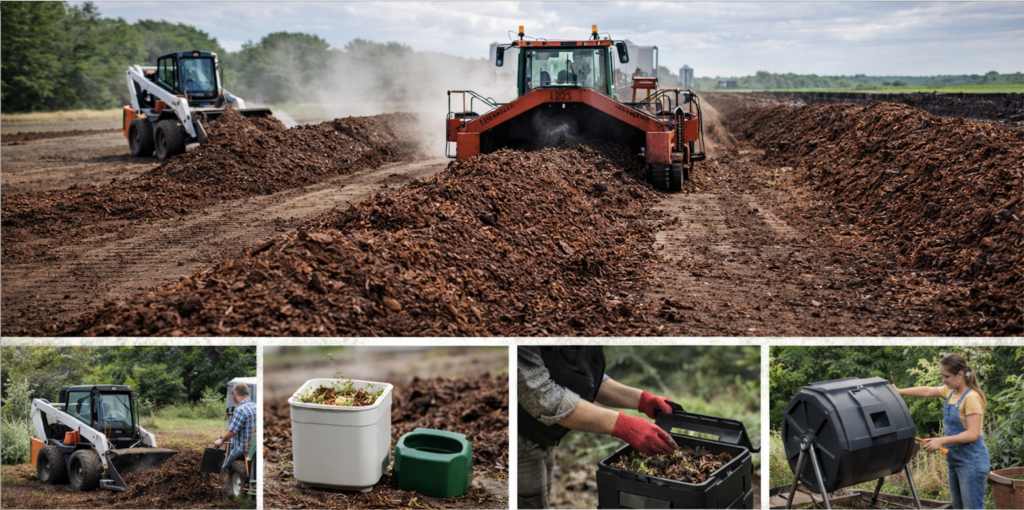
Small tumbling bins introduce mechanical aeration. Tumblers accelerate decomposition by allowing controlled turning without tools, making them well-suited for small yards where manual turning would be impractical. Tumblers offer faster compost cycles but typically hold less volume than large stationary systems.
Dual-chamber tumblers add the advantage of staggered batches. One chamber matures while the other receives fresh waste. This is highly efficient for households that generate consistent kitchen scraps but lack the space for multiple bins.
Slim or vertical bins address footprint constraints directly. These units compress width and depth while increasing height, allowing composting along fences or narrow side yards. They trade ease of turning for footprint efficiency, making them best for households with minimal lawn area.
Worm-assisted bins (vermicomposters) provide high-efficiency biological processing at low volumes. They excel at handling kitchen scraps with minimal odor and produce castings valued for garden enrichment. Best suited for gardeners focused on soil quality rather than volume of compost.
Matching bin type to household behavior improves outcomes. Light scrap households—those cooking modestly and producing minimal yard waste—benefit from compact stationary bins or vermicomposters. Moderate scrap households—with regular cooking and seasonal clippings—perform better with tumblers or dual-chamber systems. High scrap households—cooking frequently, juicing, or gardening intensively—require staggered systems or supplemental countertop storage.
Gardeners with shared yards or entertaining spaces benefit from visually discreet bins that store flush against fences. Balcony or patio gardeners face volume limitations and benefit from worm bins or other low-odor biological systems. Gardeners prioritizing soil health may integrate vermicomposting solely for castings. Those prioritizing waste reduction may choose tumblers for faster throughput.
Gardeners with small yards should choose bins based on input volume, airflow performance, ergonomics, and pest control. Compact stationary bins work for low-intensity households and maximize discretion. Tumblers improve throughput and minimize maintenance, while dual-chamber models suit year-round cooking households that want continuous processing. Vertical or slim bins solve footprint limitations along fences or side yards. Vermicomposters reward gardeners focused on soil improvement rather than raw compost volume. Selecting the right class ensures faster cycles, cleaner operation, and a better fit between lifestyle and limited space.
CITATIONS:
1. Cornell Waste Management Institute, 2004. Compost Microbiology and Decomposition, Cornell Cooperative Extension.
2. U.S. Environmental Protection Agency, 2018. Reducing the Impact of Waste: Composting in Small Spaces, EPA Municipal Solid Waste Program.
3. University of California Agriculture & Natural Resources, 2017. Home Composting for Small Gardens and Yards, UC ANR Publication 21514.
4. Washington State University Extension, 2019. Composting in Small Spaces: Methods, Materials, and Management, WSU Extension Publications.
5. Oregon State University Extension Service, 2020. Backyard Composting: Materials, Methods, and Considerations, OSU Extension Publication EM 9303.
6. Rodale Institute, 2015. Comparison of Small and Mid-Scale Compost Systems for Food Waste, Rodale Research Brief.
7. Rutgers Cooperative Extension, 2016. Organic Waste Management in Suburban Yards, Rutgers New Jersey Agricultural Experiment Station.
8. Illinois Extension, 2021. Composting: Bins, Tumblers, and Worms, University of Illinois Extension Horticulture Series.
9. University of Vermont Extension, 2020. Vermicomposting Systems for Urban and Small-Space Growers, UVM Center for Sustainable Agriculture.
10.American Society for Horticultural Science, 2014. Effects of Container Volume and Aeration on Composting Rates, HortScience.
META
META TITLE:
Best Compost Bins for Small Yards (2025 Buying Guide)
META DESCRIPTION:
Compare compost bin options designed for small yards. Learn how airflow, capacity, and design affect composting performance in compact garden spaces.
PRIMARY KEYWORD:
compost bins for small yards
SECONDARY KEYWORDS:
small yard compost bins
compact compost bins
SEARCH INTENT:
Commercial/Informational Hybrid (B→C intent)
URL SLUG:
best-compost-bins-small-yards
CATEGORY SILO:
Compost Bins → Small Space Solutions
HOMEPAGE SUMMARY
Small yards demand compost systems that balance airflow, odor control, and limited footprint. Compact compost bins allow gardeners to process kitchen scraps and light yard waste without sacrificing walkway space or aesthetics. Several equipment classes serve this need, including compact stationary bins, small tumblers, dual-chamber systems, slim vertical bins, and vermicomposters. Airflow performance, capacity, materials, and pest resistance determine whether a system fits a household’s scrap generation habits and space constraints. Tumblers accelerate decomposition through mechanical aeration, while worm-based systems produce castings prized for soil health. Selecting the right bin depends on input volume and lifestyle. Compact bins suit low-scrap households, tumblers improve throughput, and vermicomposters excel in patios or balconies with minimal odor. Small-yard composting offers gardeners a practical way to recycle organic waste and improve garden soils even when outdoor space is limited.
GROWER’S NOTES
Gardeners working in small yards quickly discover that composting is not just about volume—it is about workflow and space efficiency. Systems that require long-handled tools or wide turning arcs become difficult to operate near patios, fences, or raised beds. Low-profile bins keep visual clutter down, but airflow limitations slow decomposition. Tumblers solve the airflow problem but reduce volume and may not handle dense seasonal waste. Dual-chamber systems provide the most consistent cycle for year-round cooking households, allowing one chamber to mature while the other receives fresh input.
Vermicomposting is uniquely useful in small yards and balconies where soil improvement is the priority. Worm bins convert kitchen scraps into castings that blend well into containers and raised beds, improving structure and water retention. Gardeners focused on soil health rather than waste throughput often prefer worm systems for their control and low odor. Regardless of system, small-yard gardeners should remain consistent with feedstock inputs and avoid overloading bins with dense materials that slow decomposition or attract pests.
